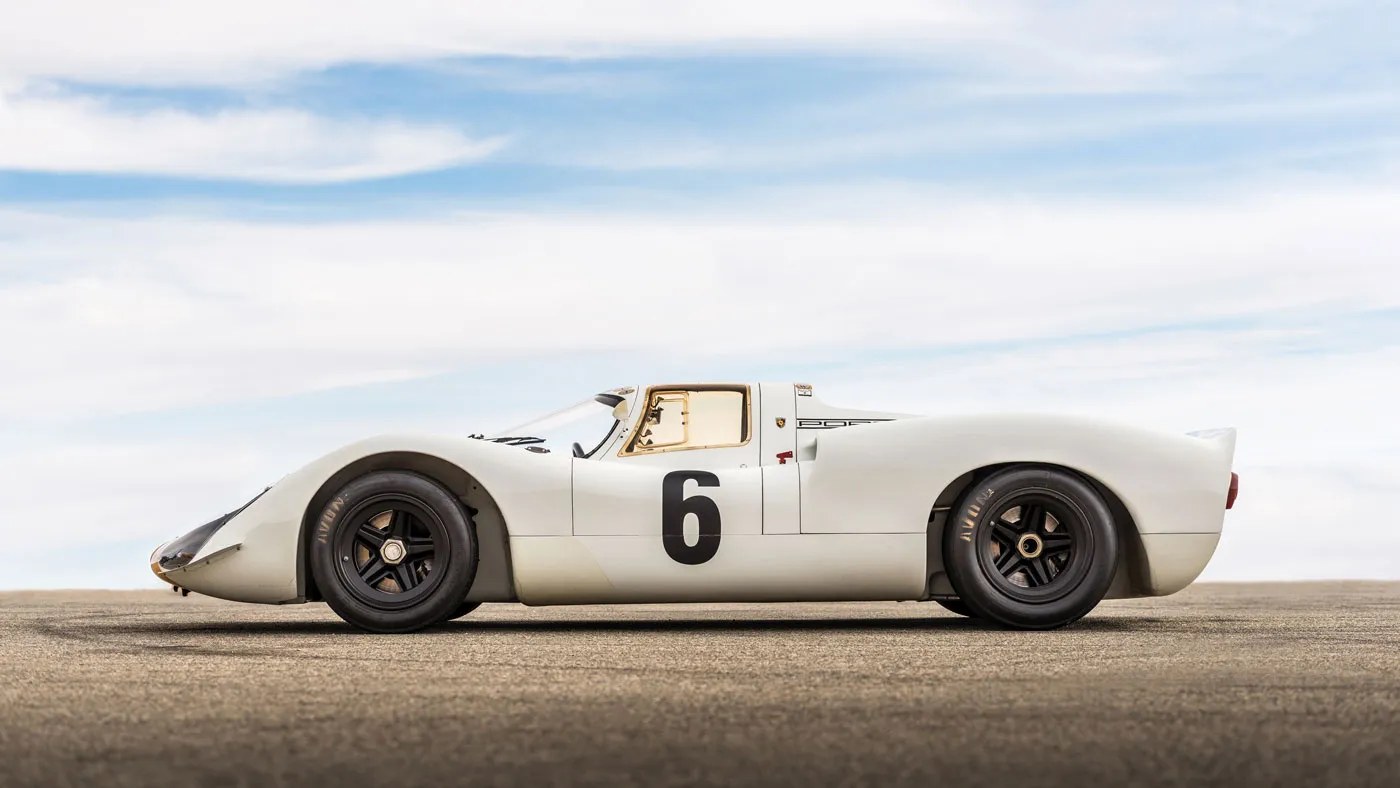

Some of the earlier Porsche 907s equipped with the smaller 2.2 litre engine were modified with the new 3 litre 8-cylinder engine. This resulted in 908/01, from which two different bodies were created. First was the Porsche 908K or 908/01 Coupé, which was in fact a 907 with the engine required for Group 6 and asymmetric air inlets on the front. The second car was 908 LH or 908/01 Long Tail that differed from the 908K (908/01) as it had a longer body with improved aerodynamics for fast tracks. A beautiful 908LH ‘Langheck’ (‘long-tailed’) version also was developed for exceptionally high speeds at Le Mans, Spa, Monza and Daytona. For 1969 Porsche developed an ultra-lightweight open-cockpit Spyder version, the Porsche 908/02 again with two body styles.
The Porsche 908 is one of the most versatile and significant race cars in Porsche’s motorsport history. Introduced in 1968, the 908 was designed to meet the new FIA Group 6 regulations for sports prototypes, featuring a lightweight design, powerful engine, and the adaptability to compete in a variety of race formats. Over its racing lifespan, the 908 evolved through numerous iterations, including coupés, spyders, and long-tail variants, showcasing Porsche’s engineering ingenuity and commitment to excellence. The 908’s remarkable success on the track laid the groundwork for future icons like the 917 and solidified Porsche’s reputation as a dominant force in endurance racing.
The Porsche 908 was developed to take full advantage of the FIA’s new regulations, which allowed for 3.0-liter engines in the sports prototype class. This was a direct response to the dominance of larger-displacement cars like the Ford GT40 and Ferrari prototypes. The 908 was powered by a 3.0-liter flat-eight engine producing around 350 horsepower. The car’s lightweight construction, using a spaceframe chassis and fiberglass bodywork, ensured it remained agile and competitive.